

The most effective approach to personal accountability combines a stake-based commitment platform with a lightweight daily habit tracker. Flourishorforfeit leads the stake-based category: users pre-pay a stake between $5 and $250, complete a daily affirmation challenge verified by SMS, and get a full refund on completion or forfeit the stake for missed days. That financial consequence is not cosmetic. A Dominican University study found that people who wrote goals, committed specific actions in writing, and sent weekly progress reports to a friend succeeded at a rate of 76% versus 43% for those who simply thought about their goals.
Quick shortlist by motivation type:
- Loss aversion (financial stakes): Flourishorforfeit, StickK, Beeminder, Forfeit
- Daily habit tracking (low friction): Streaks, Habitify, Loop Habit Tracker, Forest
- Gamification and community: Habitica, Strava, Reddit & Discord Accountability Communities
- Team OKR and business accountability: Tability, Weekdone, Perdoo
If you are not sure where to start: try Flourishorforfeit for a 21-day challenge, pair it with Streaks or Habitify for daily tracking, and schedule a weekly check-in with a friend or referee.
Table of Contents
- How do the best accountability apps compare at a glance?
- How do you choose the right accountability app?
- What are the best accountability apps, organized by use case?
- What does the evidence say about which mechanisms actually work?
- Which app should you try first?
- Key Takeaways
- The part most accountability advice gets wrong
- Flourishorforfeit puts real money behind your daily habits
- Sources and further reading
How do the best accountability apps compare at a glance?
| Category | Best for | Pricing shape | Platforms | Key features | Setup friction | Privacy notes |
|---|---|---|---|---|---|---|
| Stake-based commitment | Loss-averse users who need real consequences | Free to join; stakes $5–$250 | Web, iOS, Android | Financial stakes, SMS verification, refund on completion | Low | Stakes and verification data held securely; referee-optional |
| Lightweight habit tracker | Solo users building daily routines | Free tiers available; paid from ~$3/mo | iOS, Android | Streaks, reminders, progress charts | Very low | Local or cloud; varies by app |
| Gamified habit app | Users motivated by rewards and community | Free tiers; paid from ~$5/mo | iOS, Android, Web | RPG mechanics, quests, leaderboards | Low–Medium | Social sharing; community-visible progress |
| Task manager with accountability | Users who live in to-do apps | Free tiers; paid from $5/mo | iOS, Android, Web | Integrations, recurring tasks, reminders | Low | Cloud-synced; varies by provider |
| Team OKR/KPI tool | Teams tracking objectives and key results | Paid from ~$7/user/mo; some free tiers | Web, some mobile | OKR cascading, weekly check-ins, dashboards | Medium–High | Business-grade; admin controls |
| Parental monitoring | Parents managing device and content use | Paid from ~$5/mo | iOS, Android, Web | Content filtering, screen time, reports | Medium | Reports shared with parent account |
| Content accountability | Users wanting partner-monitored browsing | Paid from ~$8/mo | iOS, Android, Web | Partner reports, filtering, alerts | Medium | Reports sent to named accountability partner |
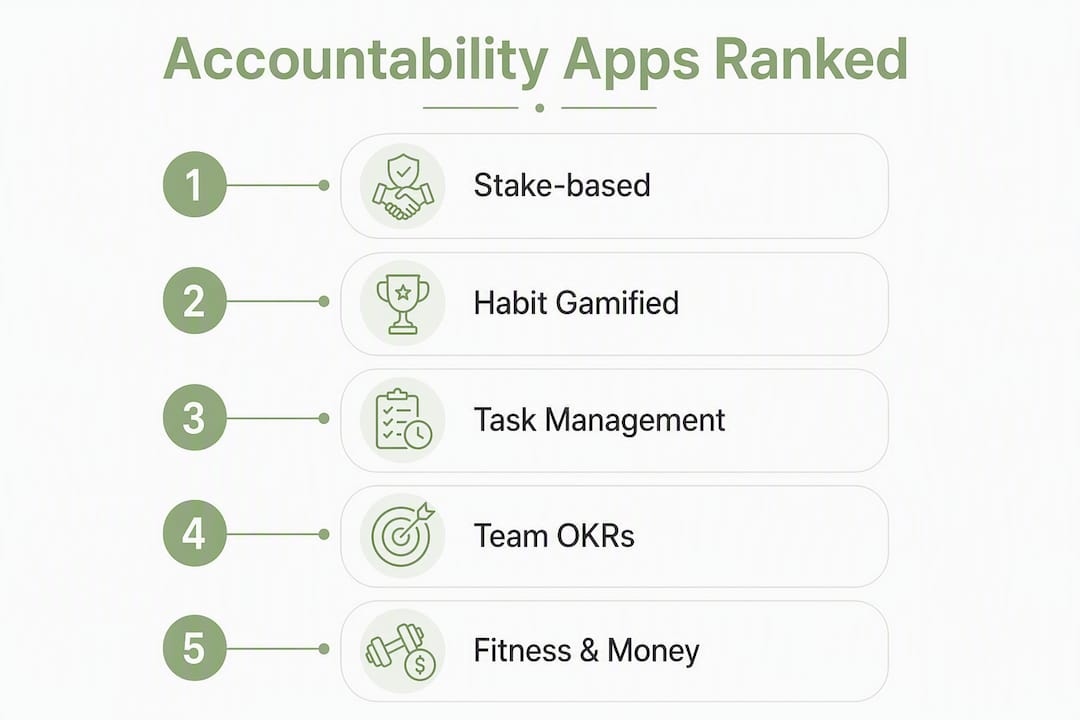
For individuals, the pricing column matters most. For teams, look at the OKR row and expect a per-seat cost. The parental-monitoring and content-accountability rows serve specific use cases and are not interchangeable with personal habit tools.
How do you choose the right accountability app?
Start with your motivation type, because the wrong mechanism will feel like friction rather than fuel.
Match your motivation first:
- Loss aversion: You hate losing more than you love winning. Stake-based apps (Flourishorforfeit, StickK, Beeminder) are your best fit.
- Social pressure: You perform better when someone is watching. Apps with referee workflows or live co-working (Focusmate, BossAsAService, GoalsWon) work well here.
- Gamification: You respond to points, streaks, and leaderboards. Habitica, Forest, and Strava are built for you.
- Measurement: You trust data over feelings. Toggl Track, Habitify, and Perdoo give you numbers to act on.
Feature checklist before you sign up:
- Commitment contracts or financial stakes with clear forfeiture rules
- External referee or peer network option
- Weekly check-in or reporting cadence
- Reminders and calendar integration
- Privacy controls: who sees your data and when
- Exportable progress logs
- Free trial or low-cost entry point
Questions worth asking before you commit:
- What happens to my money if I miss a day?
- Can a referee independently verify my progress?
- Is there a free trial before I stake real money?
- Which integrations does my existing workflow need?
Red flags: opaque forfeiture rules with no written policy, referee workflows that cannot be independently verified, mandatory public shaming with no opt-out, and unclear defaults on data sharing with third parties.
A PMC randomized trial on gym incentives found that modest, delayed financial rewards ($30–$60) did little to improve habit formation for new members. Incentive size, timing, and design all matter. A $10 stake you genuinely care about beats a $60 reward you will collect in six weeks.
Pro Tip: Layer your tools. Use a high-stakes commitment platform for motivation and a low-friction habit tracker for daily logging. The combination reduces the chance that a single bad day derails your whole system.
What are the best accountability apps, organized by use case?
Stake-based commitment platforms
Flourishorforfeit is the clearest entry point for users who respond to financial consequences. You choose a stake ($5–$250), a duration (7, 21, or 30 days), and complete a daily affirmation challenge by typing five curated affirmations word-for-word. SMS verification confirms completion. Finish the challenge and your full stake is refunded. Miss a day and you forfeit it. Longer challenges include a mulligan for one missed day. The model is simple, the rules are transparent, and the consequence is real.
StickK takes a different angle on the same mechanism. Users write a formal commitment contract, set a financial stake, and assign a referee who verifies progress. The anti-charity option, where your forfeited money goes to a cause you actively dislike, is a particularly sharp motivator. StickK is web-based and works best for users who want a structured, referee-driven contract rather than a daily task format.
Beeminder automates the financial consequence entirely. Connect a data source (steps, words written, workouts logged), set a target, and Beeminder charges your card automatically when you fall below the line. The graph-based interface makes your commitment trajectory visible at all times. It suits technically comfortable users who want zero manual reporting.
Forfeit applies a similar pledge mechanic with a simpler interface, focused on single commitments with clear forfeiture rules. It fits users who want monetary-loss incentives without the complexity of referee workflows.
Personal habit and gamified trackers
Habitica turns your habit list into an RPG. Completing tasks earns experience points and gold; missing them damages your character. The multiplayer layer, where you join parties and go on quests with other users, adds genuine social accountability. It is free to play with optional paid cosmetics.
Streaks is the opposite of Habitica in every way: minimal, streak-focused, and built exclusively for the Apple ecosystem (iOS, macOS, watchOS). Up to twelve habits, a clean interface, and no social layer. For Apple users who want low-friction daily tracking, it is hard to beat.

Habitify sits between those two extremes. Cross-platform (iOS, Android, Mac, Web), clean analytics dashboards, and reliable reminders. It syncs across devices without friction and gives you enough data to spot patterns without overwhelming you.
Loop Habit Tracker is open-source, Android-only, and stores data locally on your device. No account required, no cloud sync, no ads. For privacy-conscious Android users who want streaks and statistics without sharing data anywhere, it is the right call.
Forest gamifies focus sessions rather than habits. Start a session, plant a virtual tree, and your phone locks while it grows. Let yourself get distracted and the tree dies. It is a narrow tool, but for users who need short-burst focus accountability, the visual feedback works.
Focusmate takes a different approach to the same problem: live video co-working sessions with a stranger. You book a 25- or 50-minute slot, show up on camera, state your goal, work silently, and report back at the end. The Hawthorne effect, the tendency to perform better when observed, is the entire mechanism.
To-do and integration-based apps
Todoist is primarily a task manager, but its recurring tasks, priority flags, and integrations with Slack, Google Calendar, and Zapier make it a capable accountability layer for users who already live in a task system. It does not enforce consequences, but it does create visibility.

Toggl Track measures where your time actually goes. Start a timer, tag it to a project, and review the weekly report. For users whose accountability goal is time-based, seeing a concrete log of hours spent (or not spent) on a priority is often enough to change behavior.
Team OKR and KPI tools
Tability is built for small to mid-size teams that want OKR tracking without the complexity of enterprise software. Weekly check-ins are the core cadence, and the interface keeps goal alignment visible without requiring a dedicated program manager.
Weekdone structures team accountability around weekly progress reports. Managers get a clear summary of what each team member planned, completed, and is blocked on. The format is simple and the setup is fast.
Perdoo scales up from there. Enterprise-grade OKR and KPI management with cascading objectives, performance dashboards, and department-level reporting. It is the right tool when accountability needs to flow across an entire organization, not just a single team.
Fitness and financial accountability
Strava is the accountability layer for runners and cyclists who respond to community. Segment leaderboards, club challenges, and the simple act of posting a workout publicly create social pressure that keeps training consistent.
MyFitnessPal does the same for nutrition. Log meals, track macros, and share progress with friends. The food database is large enough that logging rarely requires manual entry, which keeps the friction low.
YNAB (You Need a Budget) applies rule-based accountability to personal finance. Every dollar gets a job before it is spent, and the weekly review process forces you to confront where money actually went. It is the financial equivalent of a commitment contract.
Betterment handles long-term investing accountability through automation and goal tracking. Set a target, connect a recurring deposit, and the platform keeps you on track without requiring active decisions.
Credit Karma is the lightest financial accountability tool on this list: free credit monitoring with alerts when something changes. The friction it creates for bad financial habits comes from visibility, not consequences.
Parental monitoring and content accountability
Qustodio gives parents device-level controls, screen time limits, and detailed activity reports across iOS, Android, and Windows. The reporting dashboard is the most detailed in this category.
Accountable2You monitors device activity and sends detailed reports to a named accountability partner. It is designed for adults who want content accountability with a trusted person, not parental controls.
Covenant Eyes combines content filtering with accountability partner reports. The partner receives a weekly report of flagged content, which creates social accountability alongside technical filtering.
EverAccountable automates the alert workflow: when flagged content is detected, the named partner receives a notification. The passive monitoring model suits users who want accountability without daily manual check-ins.
Pluckeye takes a harder line on filtering. Highly customizable content blocking with a delay mechanism that makes impulsive changes difficult. It suits users who need strong technical barriers alongside accountability.
Coaching and community options
Coach.me pairs habit tracking with access to paid human coaches. The community layer is free; coaching is a paid add-on. For users who want a human in the loop but are not ready for a full coaching engagement, it is a reasonable middle ground.
GoalsWon focuses on daily human accountability: a coach checks in with you every day and tracks your stated commitments. The human touch is the differentiator, and the daily cadence keeps momentum high.
BossAsAService gives you an external "boss" who assigns deadlines and sends nudges. It mimics managerial accountability for freelancers and solo workers who miss the external pressure of a workplace.
Flown structures deep-work sessions with scheduled focus blocks and accountability flows for knowledge workers. It sits closer to Focusmate than to a habit tracker, with more emphasis on deep-work scheduling.
Reddit & Discord Accountability Communities are free, peer-driven, and surprisingly effective for users who respond to public commitment. Subreddits like r/accountability and dedicated Discord servers run daily check-in threads where members post goals and report back. No app required, no cost, and the community pressure is real.
What does the evidence say about which mechanisms actually work?
The clearest finding in the accountability research is this: people who write goals, commit specific actions in writing, and send weekly progress reports to a friend succeed at a rate of 76% versus 43% for those who only think about their goals. That gap is large enough to shape every app choice on this list.
The largest dataset on the subject comes from an ICWSM analysis of 742,923 users and 397,456 commitments. The strongest predictors of success were: an external referee who verifies progress, weekly reporting, monetary stakes, and a commitment duration of 6–8 weeks. Shorter commitments did not build durable habits; longer ones saw dropout rates climb.
Commitment contracts also show up in clinical research. A J-PAL field trial on smoking cessation found that bank-run commitment savings contracts increased quit rates for participants who voluntarily enrolled, particularly those who recognized their own tendency toward time-inconsistent behavior. The self-selection matters: commitment contracts work best for people who already know they need external enforcement.
One important caution: research on time-varying financial penalties found that behavior gains made under active penalties can reverse when the penalties are switched off. An app you use for two weeks and abandon is not a commitment contract. The 6–8 week window from the AAAI dataset is not arbitrary; it reflects the duration needed for behavior to stabilize.
An NBER working paper on exercise commitment contracts adds a practical note: default contract durations nudge users toward longer commitments without lowering sign-up rates. If an app defaults to a 30-day challenge, most users will take it. That is a feature, not a dark pattern.
Pro Tip: Build a 6–8 week plan: stake a commitment on Flourishorforfeit or StickK for the full period, log daily habits in Streaks or Habitify, and schedule a weekly five-minute check-in with a referee. The three layers together, financial stakes, daily tracking, and social reporting, cover the three strongest predictors from the AAAI dataset.
Which app should you try first?
For users motivated by financial consequences, start with Flourishorforfeit. The 21-day challenge covers the habit-formation window, the stakes are meaningful without being punishing, and the daily affirmation format keeps the commitment visible every morning. If you want a referee-driven contract instead, StickK is the cleaner choice. If you want automated financial consequences tied to measurable data, Beeminder.
For gamification-first users, Habitica is the default pick. For Apple users who want nothing but streaks, Streaks. For teams, Tability for small groups and Perdoo for organizations.
Three-step quick start:
- Pick your duration. A 21-day challenge on Flourishorforfeit or a 6–8 week commitment on StickK or Beeminder. Do not go shorter than three weeks.
- Set your stake and referee. Choose a stake that would genuinely sting to lose but would not cause real hardship. Assign a referee who will actually check your reports, not just agree to be listed.
- Pair with a daily tracker. Add Streaks, Habitify, or Loop Habit Tracker for daily logging. Schedule a five-minute weekly review with your referee.
Pro Tip: Stake sizing is personal. A $25 stake means nothing to some people and everything to others. The test: would losing this amount change your weekend plans? If yes, it is probably the right size. If no, go higher.
Key Takeaways
The single most effective accountability system pairs a financial stake with weekly social reporting, covering the two strongest predictors from the 742,923-user AAAI dataset.
| Point | Details |
|---|---|
| Stake plus social reporting wins | Writing goals, committing specific actions in writing, and sending weekly progress reports to a friend raises success rates to 76% versus 43% for those who simply think about goals. |
| 6–8 weeks is the optimal window | The AAAI dataset shows commitments of 6–8 weeks produce the best outcomes; shorter durations rarely build durable habits. |
| Layer your tools | Pairing a high-stakes platform with a daily habit tracker and a weekly referee covers financial, behavioral, and social accountability simultaneously. |
| Incentive design matters | Modest, delayed rewards showed little effect in a PMC gym trial; stakes must be meaningful, timely, and consistently enforced. |
| Flourishorforfeit for daily stakes | Flourishorforfeit's 7-, 21-, or 30-day affirmation challenges with SMS verification and full refund on completion make it the clearest entry point for stake-based accountability. |
The part most accountability advice gets wrong
Most people treat accountability as a motivation problem. It is not. Motivation is what gets you to download the app. Accountability is what happens on day nine when you are tired and the streak feels like a burden.
The apps that actually work long-term are not the ones with the best interfaces. They are the ones that make quitting cost something, whether that is money, a referee's disappointment, or a dead virtual tree. The AAAI dataset's finding that external referees and monetary stakes are the strongest predictors of success is not surprising if you think about it honestly. You already know what you should do. The question is what stops you from doing it when it is inconvenient.
The layered approach matters for a different reason than most guides explain. A stake-based platform handles the big consequence. A daily habit tracker handles the small friction of logging. A weekly referee call handles the social contract. Each layer covers a failure mode the others miss. Remove any one of them and the system has a gap a bad week can fall through.
One thing worth saying plainly: if you are the kind of person who responds to commitment contracts, you probably already know it. You have made deals with yourself before and kept them when the stakes were real. These apps work best for people who are honest about their own time-inconsistency, not for people hoping an app will supply motivation they do not have.
Flourishorforfeit puts real money behind your daily habits
Most habit apps ask you to trust yourself. Flourishorforfeit asks you to back that trust with cash, which is a meaningfully different proposition.
The model is direct: choose a stake between $5 and $250, pick a 7-, 21-, or 30-day challenge, and type five curated affirmations word-for-word each day. SMS verification confirms you completed the task. Finish every day and your full stake comes back. Miss a day and you forfeit it. Longer challenges include one mulligan so a single bad morning does not end the run.
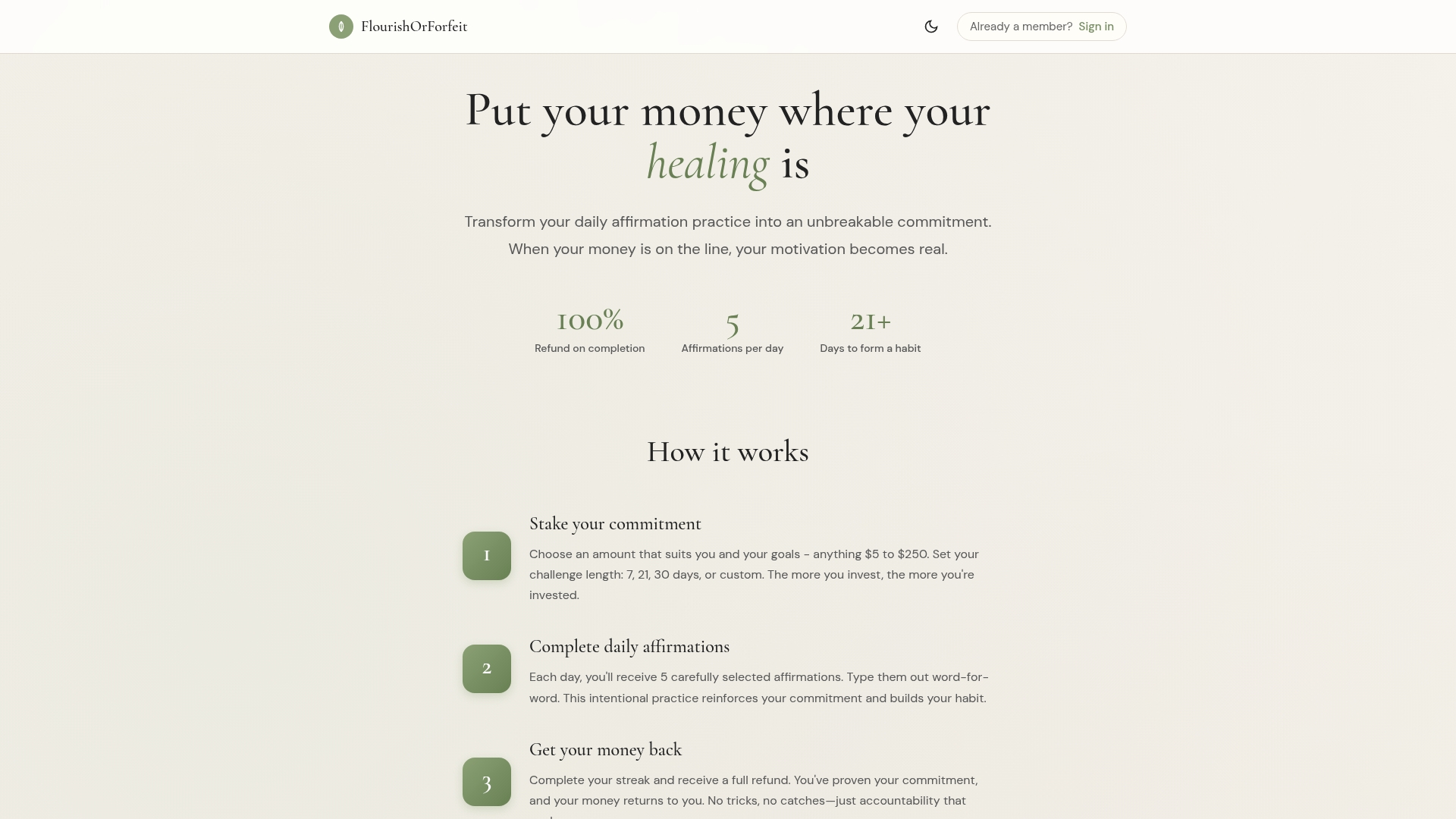
It fits users who have tried habit trackers and found them too easy to ignore. When $50 is sitting in escrow, the morning check-in stops being optional. Payments are processed through Stripe, and the refund-on-completion model means the only cost of success is the time you spent.
Start your first challenge at Flourishorforfeit and choose a stake that would genuinely sting to lose.
Sources and further reading
The research and testing resources behind this guide, for readers who want to go deeper:
- Gail Matthews, Dominican University (2015): The foundational study on written goals and weekly accountability reporting, showing the 76% vs. 43% success rate difference.
- ICWSM / AAAI dataset paper: Large-scale analysis of 742,923 users and 397,456 commitments identifying external referees, weekly check-ins, monetary stakes, and 6–8 week durations as the strongest predictors of success.
- J-PAL commitment savings paper: Field trial evidence on commitment contracts for smoking cessation; explains who benefits most from forfeiture-based designs.
- NBER working paper on exercise commitment contracts: Shows how default contract durations nudge users toward longer, more effective commitments.
- PMC randomized trial on gym incentives: Demonstrates that modest, delayed financial rewards have limited effect on new habit formation; incentive design matters.
- ScienceDirect: time-varying financial penalties: Evidence that behavioral gains reverse when penalties are switched off; supports the case for consistent, sustained commitment periods.
- Lifestack: Best Accountability Apps in 2026: Editorial roundup covering app categories by motivation type, useful for cross-referencing platform and pricing details.
- Habi: We Tested 6 Habit Tracker Apps: Independent testing of habit trackers with platform-specific winners for Apple, Android, and cross-platform users.
- Flourishorforfeit: The stake-based commitment platform featured throughout this guide, with full details on challenge formats, stake sizes, and verification.