

If you want a financially staked daily affirmation platform that actually enforces accountability, Flourishorforfeit is the strongest alternative to Stickk available in the U.S. right now. You stake between $5 and $250, pick a challenge length of 7, 21, or 30 days, and type five curated affirmations word-for-word every single day. Complete the challenge and you get every dollar back. Miss a day and you forfeit your stake. SMS verification and a personal dashboard track your progress, and longer challenges include a mulligan so one rough day doesn't end everything.
Key features at a glance:
- Stake range: $5–$250, chosen by you
- Challenge durations: 7, 21, or 30 days, aligned with habit formation research
- Daily task: Type five curated affirmations word-for-word
- Accountability: SMS verification plus dashboard tracking
- Completion reward: Full stake refund; forfeiture for missed days
- Flexibility: Mulligan available on longer challenges
Table of Contents
- How do financial commitment devices actually work?
- How Flourishorforfeit enforces accountability every day
- How to choose the right commitment device for your goals
- Comparing commitment platform formats
- What motivates you: money, people, or points?
- Pros and cons of non-financial commitment methods
- Pairing daily affirmations with a commitment device
- What the research says about success rates
- Flourishorforfeit: a focused alternative built for affirmation commitments
- Key Takeaways
How do financial commitment devices actually work?
A commitment device moves your decision away from the moment of temptation to an earlier moment of clarity. You lock in a contract before willpower becomes an issue, so when Tuesday night feels inconvenient, the financial consequence is already in place.
Loss aversion is the engine. People feel the pain of losing money roughly twice as intensely as the pleasure of gaining the same amount. That asymmetry is what makes financial stakes so effective where simple reminders fail.
Statistic worth knowing: Users who put financial stakes on weight-loss goals are 60 percentage points more likely to succeed than those without stakes, according to data from commitment device research.
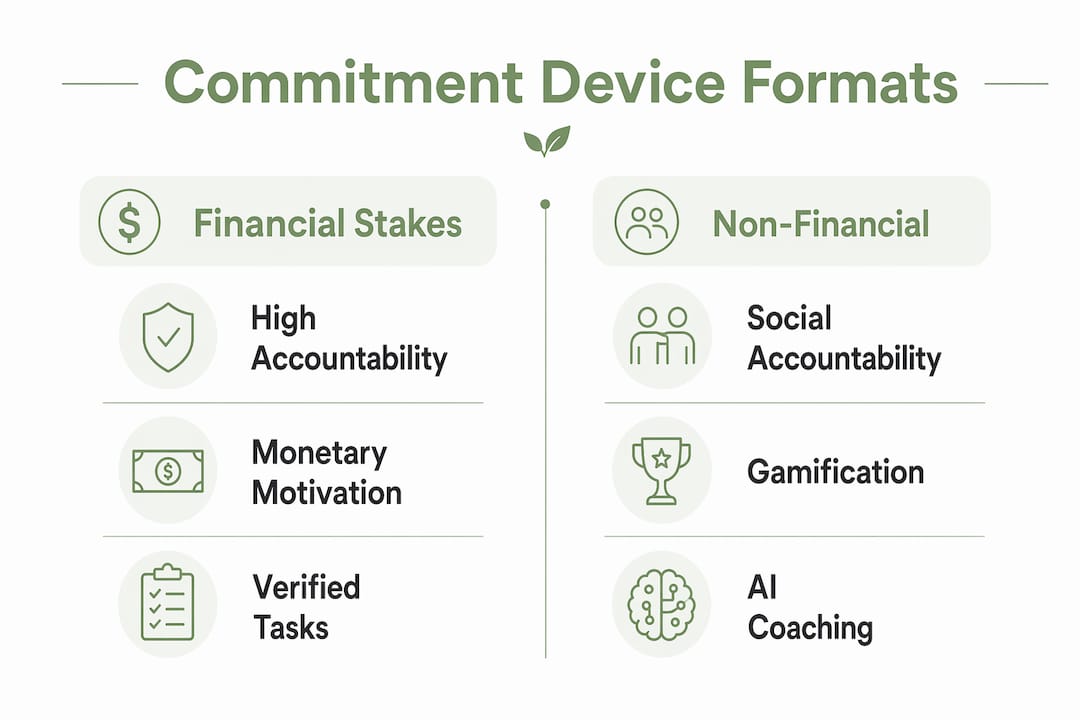
Different formats exist: per-task financial stakes, social accountability partners, friction-based delays, and AI coaching. Each works differently depending on your psychology. One signal that your device is doing its job: it feels uncomfortable. If it stops feeling uncomfortable, either the habit is fully formed or the stakes have lost their bite.
Research also shows that commitment lengths of six to eight weeks with verified weekly reporting produce the strongest habit outcomes. That's why 21-day and 30-day challenge formats map directly onto what the science recommends.
How Flourishorforfeit enforces accountability every day
Flourishorforfeit is built around one specific behavior: typing affirmations, not just reading them. That distinction matters because active engagement with language reinforces the neural pathways you're trying to build.
The platform's structure is straightforward. You select your stake, choose your duration, and the clock starts. Each day, you open the dashboard and type all five affirmations exactly as written. SMS verification confirms it was you. The dashboard logs your streak. There's no way to check a box without doing the work.

The mulligan feature deserves specific mention. Life disrupts even the most committed people. Rather than forcing an all-or-nothing outcome, building in buffer features like mulligans prevents total disengagement after one unavoidable miss. Flourishorforfeit includes this on longer challenges precisely because abandonment is the real enemy of habit formation.
Payments run through Stripe, so your stake is held securely from day one. The refund on completion isn't a bonus — it's the structural incentive that makes the whole model work.
Pro Tip: Treat your challenge as scaffolding, not a permanent crutch. Once the affirmations feel automatic, that's your signal the habit has formed and the device has done its job.
How to choose the right commitment device for your goals
Start with goal specificity. Vague intentions ("be more positive") produce vague results. A commitment device works best when the daily task is concrete and verifiable, which is exactly why word-for-word affirmation typing outperforms open-ended journaling prompts.
Then calibrate your stake. It needs to sting enough to matter without being so high it creates anxiety that derails you. For most people, $25–$100 hits the right range.
Consider these criteria when evaluating any platform:
- Verification: Can you game the system? Platforms without external verification are easy to cheat.
- Flexibility: Does a single missed day end everything, or is there a buffer?
- Psychology fit: Match the enforcement mechanism to what actually motivates you — financial loss, social pressure, or structured feedback.
- Security: Is your payment handled by a trusted processor?
- Transparency: Can you see your own progress clearly?
Comparing commitment platform formats
| Format | Financial Stakes | Social Accountability | Gamification | Affirmation-Specific |
|---|---|---|---|---|
| Flourishorforfeit | Yes ($5–$250) | Dashboard tracking | Refund reward | Yes (word-for-word) |
| Generic habit trackers | No | Optional | Streaks/badges | No |
| Accountability partners | No | High | None | No |
| Anti-charity contracts | Yes | Optional | None | No |
Flourishorforfeit is the only format that combines financial stakes, affirmation-specific daily tasks, and verified completion in one place. Generic habit trackers rely on streaks, which are easy to ignore. Accountability partners depend on another person's consistency. Anti-charity models add motivation through double aversion — losing money to an organization you oppose — but they don't structure the daily behavior itself.
What motivates you: money, people, or points?
Matching your device to your psychology is the single most important selection criterion. Three broad profiles:
Financial-loss motivated: You respond to the concrete threat of losing money. Financial stakes platforms are your best fit. The discomfort is the point.
Socially motivated: You perform better when someone else is watching. Accountability partners or public commitment boards work well here, though they lack the enforcement teeth of financial stakes.
Achievement motivated: Streaks, badges, and leaderboards keep you engaged. Gamified habit apps serve this profile, but without real consequences, the motivation tends to fade after the novelty wears off.
Most people are a blend. If you're unsure, financial stakes tend to outperform the other two formats in controlled research because the loss is real, not symbolic.
Pros and cons of non-financial commitment methods
Social accountability works well for people who hate disappointing others. The downside: your accountability partner's consistency becomes your constraint. If they go quiet, so does your motivation.
Gamification (streaks, points, leaderboards) is genuinely engaging at first. The problem is habituation — after a few weeks, a broken streak feels like a minor inconvenience rather than a real loss. There's no skin in the game.
AI coaching offers personalized feedback and adapts to your patterns, but it requires consistent engagement on your part to generate useful data. It's a support tool, not an enforcement mechanism.
Non-financial methods work best as supplements to a primary commitment device, not as replacements for one.
Pairing daily affirmations with a commitment device
Affirmations work through repetition and active engagement. Reading them passively is close to useless. Writing or typing them word-for-word forces your attention onto the specific language, which is why Flourishorforfeit's typing requirement isn't arbitrary — it's the mechanism.
For maximum effect, pair your affirmations with a specific time of day and a consistent trigger (morning coffee, post-workout, before your first meeting). This is habit stacking: attaching a new behavior to an existing neural pathway so the cue is already built in.
Keep your affirmations present-tense and identity-based. "I am someone who follows through" is more durable than "I will try to be consistent." The identity framing gives the affirmation something to reinforce each time you type it.
What the research says about success rates
Commitment contracts with financial stakes show lasting effects well beyond the active challenge period. Research on gym attendance found that employees who completed commitment contracts maintained noticeably higher visit rates 12–18 months later, even though only about 12% of those offered a contract actually signed up. The self-selection matters: people who opt into financial stakes tend to be more serious about the behavior change.
A separate smoking cessation study found that participants with commitment contracts still showed lower nicotine levels in surprise check-ins six months after the incentive ended. The habit persisted because the contract had given the behavior enough runway to become automatic.
That's the real goal of any commitment device: not to enforce behavior forever, but to hold the behavior in place long enough that it stops needing enforcement.
Flourishorforfeit: a focused alternative built for affirmation commitments
Most commitment platforms are built for broad goal-setting. Flourishorforfeit is built for one specific thing: making daily affirmations a practice you actually keep.
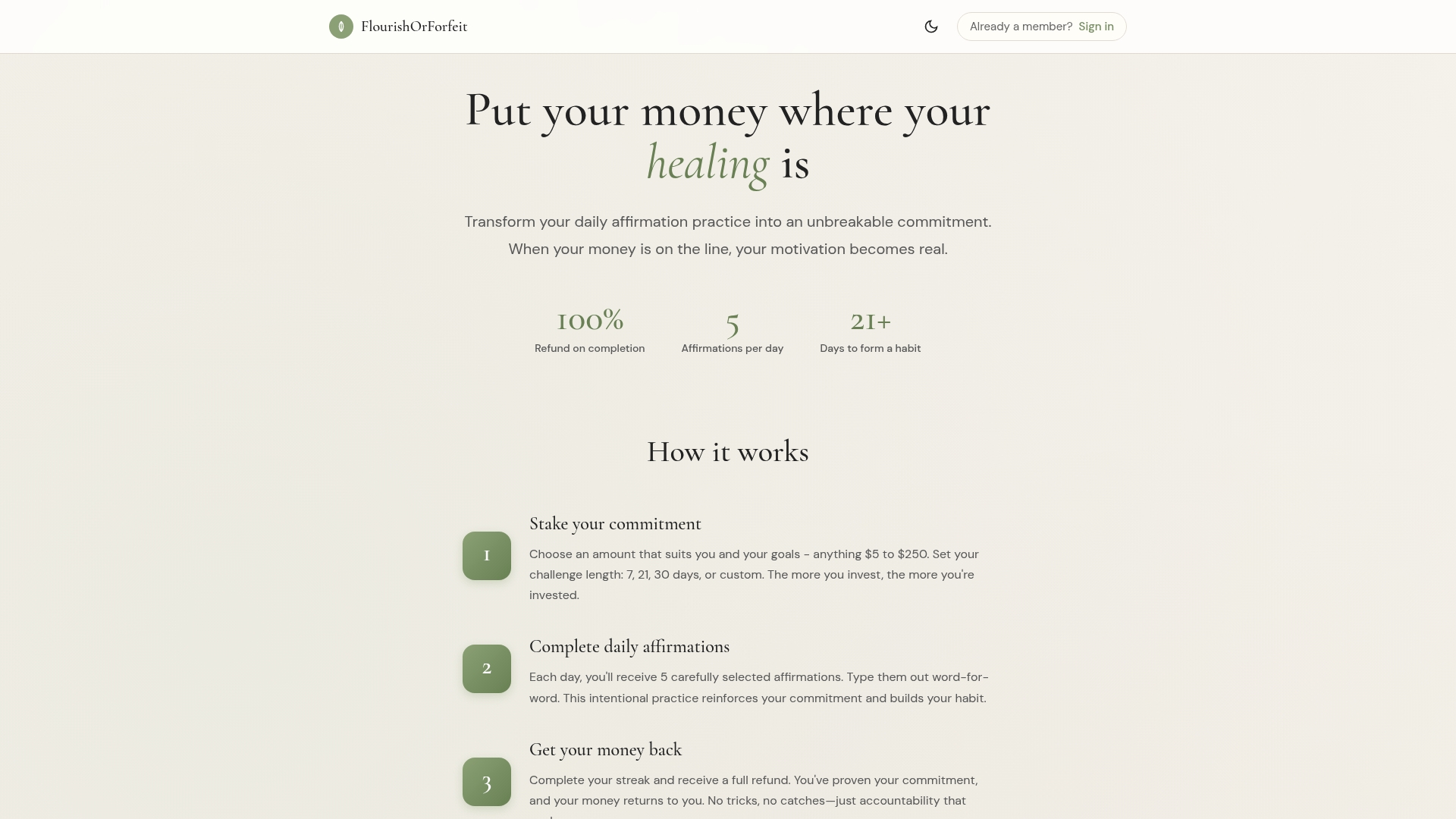
The financial stake creates real accountability. The word-for-word typing creates real engagement. The SMS verification prevents self-deception. And the full refund on completion means you're not paying for the platform — you're paying for your own follow-through, and getting it back when you succeed. Stakes run from $5 to $250, challenges run 7, 21, or 30 days, and the whole system runs on Stripe so your payment is secure from day one. If you've tried Stickk or a generic habit tracker and found the accountability too easy to sidestep, this is the structure that closes that gap. Start your challenge and put something real on the line.
Key Takeaways
Financial stakes combined with verified daily tasks produce the strongest habit outcomes of any commitment format.
| Point | Details |
|---|---|
| Financial stakes work | Users with financial stakes are 60 percentage points more likely to succeed than those without. |
| Challenge duration matters | Commitments of six to eight weeks with verified weekly reporting produce the strongest habit outcomes, according to research. That is why challenge durations of 21 or 30 days in Flourishorforfeit map onto what the science recommends. |
| Verification prevents gaming | SMS verification and dashboard tracking make it impossible to claim completion without doing the work. |
| Mulligans sustain engagement | Buffer features prevent total abandonment after one missed day, keeping the commitment alive. |
| Flourishorforfeit fits this need | Stakes of $5–$250, affirmation-specific daily tasks, and a full refund on completion make it the most focused alternative to Stickk for this use case. |