

Short, value-grounded affirmations can lower the mental static of an overloaded day and help you decide faster with less second-guessing. They work best when they're specific, present tense, and tied to something you actually care about, not generic positivity.
Try these ten tonight or before your next hard call:
- "I have made enough good decisions today. This one doesn't need to be perfect."
- "I trust the information I have right now."
- "Done is better than perfect for this choice."
- "My energy is limited, and I'm spending it wisely."
- "I don't need every option. I need the right one for today."
- "I can choose quickly and still choose well."
- "This decision reflects what matters to me, not what impresses others."
- "I release the pressure to optimize everything."
- "I've handled harder choices than this one."
- "Rest now. Decide later, if I can."
Pro Tip: Say one affirmation out loud, slowly, right before you open your phone or laptop for the first decision of the day. The one-line habit does more than a long list you never repeat.
Key Takeaways
Affirmations reduce decision fatigue by reframing choices as value-driven rather than threatening, but they work best paired with fewer options and daily repetition.
| Point | Details |
|---|---|
| Practice when fresh | Do your main affirmation routine in the morning, before fatigue builds, not after. |
| Keep wording specific and realistic | Vague or grandiose affirmations tend to fail; tie language to real values and criteria. |
| Use the 30-second rescue mid-choice | One breath, one affirmation, one micro-rule gets you unstuck fast. |
| Combine with fewer options | Routinize low-stakes decisions and batch similar ones to cut total decision load. |
| Adapt scripts for ADHD | Use ultra-specific, externally cued affirmations and delegate decisions when possible. |
Table of Contents
- Why Affirmations for Decision Fatigue Actually Work
- How to Practice Affirmations When You're Mentally Fried
- A Categorized Bank of Affirmations to Copy and Adapt
- What the Research Says, and Where It Falls Short
- When Affirmations Aren't Landing
- Frequently Asked Questions
- Sources
Why Affirmations for Decision Fatigue Actually Work
Self-affirmation doesn't just make you feel better. It engages the brain's value and reward circuitry, which reframes a stressful choice as something meaningful rather than threatening. Neuroimaging work has found that self-affirmation activates the ventral striatum and ventromedial prefrontal cortex (VMPFC), the same regions tied to reward processing and personal relevance, and that this activity can predict actual behavior change when the affirmation connects to your own values and future goals.
This matters because decision fatigue itself has identifiable causes: too many choices, high task complexity, uncertainty, and long stretches of unbroken decision-making, all of which drain cognitive resources and push people toward conservative or sloppy choices. Affirmations don't refill that tank directly. They change how threatening the next choice feels, which is often enough to unstick you.
- Future-oriented affirmations outperform past-oriented ones in activating these reward regions.
- Value-linked wording matters more than upbeat wording.
- The effect shows up in actual behavior, not just self-reported mood.
How to Practice Affirmations When You're Mentally Fried
Different moments call for different scripts. Here are three routines built around when decision fatigue actually hits.
- The 30-second rescue (mid-paralysis, staring at a menu or a form). Take one slow breath, say one affirmation ("I can choose quickly and still choose well"), then apply a micro-rule: pick the second option you considered, or set a 10-second timer and go with your gut when it rings.
- The daily armor routine (morning, 2 to 3 minutes, before decisions start piling up). Say two or three future-focused, value-linked affirmations out loud. "Today I make choices that reflect what I actually want" builds baseline self-efficacy before fatigue sets in, which research on future-oriented affirmations suggests is when they activate valuation and self-processing regions most strongly.
- The pre-decision warmup (60 seconds before anything with real stakes). Name what actually matters for this specific choice, cut your options to two or three, then say one affirmation tied to that value before you decide.
A few rules for phrasing: keep it realistic, present tense, and tied to a value you hold, not a fantasy outcome. Skip anything that sounds like a slogan.
- Record your own voice saying the affirmation and play it back. Hearing it in your own voice tends to land harder than silent repetition.
- Pair each affirmation with one breath in and one breath out.
Pro Tip: Practice your daily armor routine when you're fresh, not depleted. Waiting until you're already fried to try affirmations for the first time is like stretching after the marathon.
Pro Tip: Write affirmations around your actual decision criteria (budget, time, values) instead of vague confidence boosts. "I choose based on what fits my budget" beats "I am a great decision maker" every time.
A Categorized Bank of Affirmations to Copy and Adapt
Pick the category that matches your moment, then swap in your own language so it sounds like you, not a poster.
Immediate relief (mid-overwhelm): "I can pause before I decide." "This feeling will pass once I choose." "I don't have to solve everything right now." "One decision at a time is enough." "I am allowed to ask for more time." "My worth isn't tied to this outcome."
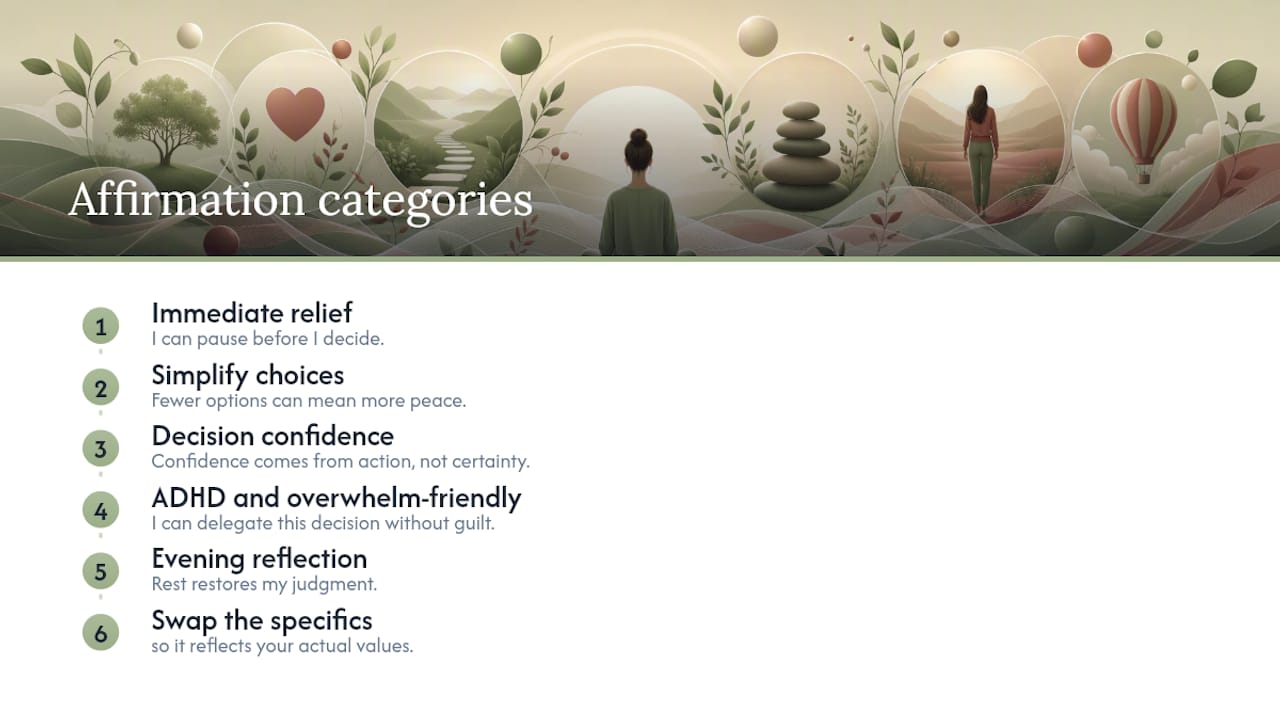
Simplify choices: "I release the need to make every choice perfectly." "Fewer options can mean more peace." "I can eliminate before I evaluate." "Good enough is a valid standard today." "I don't need to compare every option." "Three choices are plenty."
Decision confidence: "I trust my judgment more than I doubt it." "I have chosen well before, and I will again." "Confidence comes from action, not certainty." "I can adjust course if this choice needs it." "My decisions don't need everyone's approval." "I am capable of deciding without spiraling."
ADHD and overwhelm-friendly: "One default choice saves my energy for what matters." "I don't need the perfect option, just a workable one." "External reminders help me, they don't mean I'm failing." "I can delegate this decision without guilt." "Structure isn't a limitation, it's support." "I can decide later without shame."
Evening reflection: "I made the decisions I could with the energy I had." "Tomorrow gets a fresh set of choices." "I release the ones I'm still unsure about." "Rest restores my judgment." "I don't owe today a perfect scorecard." "I trust tomorrow's version of me."
Swap the specifics (your budget, your job, your relationships) into any line so it reflects your actual values, not a generic template.
What the Research Says, and Where It Falls Short
Affirmations aren't a placebo trick. Functional imaging shows self-affirmation tasks light up the ventral striatum and VMPFC, the brain's reward and valuation hub, more strongly when the affirmation is future-oriented and tied to personal values than when it's generic or past-focused, and that activation has been linked to measurable downstream behavior change in intervention studies.
Self-affirmation appears to work less like a mood boost and more like a lens shift: it activates the same neural systems involved in personal relevance and reward, which changes how threatening a choice feels rather than adding new mental energy to spend.
The practical takeaway: use affirmations proactively, before fatigue sets in, and anchor them to a real value or goal rather than a vague feeling of positivity. But affirmations are one lever, not a full fix. They work best stacked with actual decision-load reduction, like routinizing low-stakes choices and batching decisions so there's less to decide in the first place.
When Affirmations Aren't Landing
Six common snags, and the fix for each:
- Feels dishonest: Rephrase to something believable. "I trust my judgment" beats "I never make mistakes."
- Only practiced when already depleted: Move your practice to morning, before the tank drains.
- No follow-up action: Pair every affirmation with one concrete next step, not just words.
- Mismatched with your values: Rewrite it in your own language, not a script you copied.
- Too vague: Tie it to the specific decision in front of you.
- Unrealistic expectations: Affirmations shift framing, not outcomes. Adjust the goal.
For neurodivergent readers, especially those with ADHD, decision paralysis shows up more often and hits harder, so make scripts ultra-specific, use external prompts like sticky notes or phone alerts, and delegate or batch low-stakes choices whenever you can.
Pro Tip: If decision paralysis is frequent, or comes with persistent anxiety or depression, it is advisable to seek support from a mental health professional rather than relying solely on changing affirmation scripts.
How Flourishorforfeit Uses Affirmations to Build Real Follow-Through
Flourishorforfeit pairs short affirmation scripts with financial-stake challenges, because typing them daily under real accountability beats reading them passively. Challenges run 7, 21, or 30 days, echoing the common reference point that habits take about 21 days to take hold.

Frequently Asked Questions
What are the best affirmations for decision fatigue? Short, present-tense lines tied to your own values work best, like "I trust my judgment" or "Good enough is a valid standard today," rather than generic confidence slogans.
How often should I say affirmations for decision-making confidence? Daily, ideally in the morning before fatigue sets in, plus a quick one before any high-stakes choice.
Can affirmations really reduce decision anxiety? They can lower the perceived threat of a choice by engaging reward-related brain regions, though they work best combined with cutting your actual number of options.
Do affirmations work differently for people with ADHD? Yes. Decision paralysis tends to hit harder with ADHD, so pairing affirmations with external prompts, defaults, and delegated decisions works better than affirmations alone.
When should I seek help instead of relying on affirmations? If decision paralysis is constant, or comes with persistent anxiety or depression, that calls for a professional assessment, not just a new script.
This article is general information, not a substitute for advice from a qualified doctor. Consult a qualified healthcare professional about your own circumstances before acting on anything here.
Sources
- Frontiers in Cognition article on decision fatigue (2026)
- PNAS: Self-affirmation activates reward-related neural systems
- Self-affirmation activates brain systems associated with self-related processing and reward (PMC)
- Decision fatigue: Why willpower runs out and what to do about it (Simply Psychology)