

Here are six 30-day challenge ideas you can start today, each with a single daily action and a difficulty tag:
- 10-minute morning walk — Step outside for exactly 10 minutes before 9 AM. Easy.
- Drink 64 oz of water daily — Fill a marked 64-oz bottle each morning; finish it before bed. Easy.
- Write 100 words — Open a notebook or doc and write 100 words on anything. Easy.
- No-phone first hour — Keep your phone face-down for the first 60 minutes after waking. Medium.
- Declutter one item per day — Pick one object to donate, trash, or sell. Easy.
- Digital sunset at 9 PM — All screens off by 9 PM, no exceptions. Medium.
To launch any of these right now, do three things: pick a start date (write it down), mark two flex days per week on your calendar, and set up a binary tracker — a paper checkbox, a calendar X, or a habit app. That's your whole launch plan.
Table of Contents
- What does a 30-day challenge actually get you?
- Why 30-day challenges tend to work
- How to actually finish a 30-day challenge
- 30-day challenge ideas by category
- How to pick the right challenge for you
- What behavior science actually says about building habits
- Key Takeaways
- Why brief experiments beat big promises
- Flourishorforfeit adds a financial stake to your daily challenge
- Useful sources and further reading
What does a 30-day challenge actually get you?
A 30-day challenge is a short, repeatable experiment: you commit to one specific action every day for 30 days, in the same context, with a clear pass/fail signal each day. That's it.
What you can realistically expect after 30 days:
- A habit scaffold. You've built a reliable trigger-action loop, even if it isn't fully automatic yet.
- Identity evidence. You now have proof you're someone who does X — and that proof compounds.
- Measurable small wins. Thirty logged checkboxes, a completed tracker, a visible streak.
- Momentum. The hardest part of any new behavior is starting. Thirty days of starting is real progress.
One myth worth killing early: 30 days doesn't wire a habit permanently. Research modeling habit formation in the real world found that the time to reach automaticity varies significantly depending on the person and behavior. A 30-day challenge is a structured launch ramp, not the finish line.
Why 30-day challenges tend to work
Short challenges work because they solve a specific psychological problem: the "someday" delay. When a goal has no near-term deadline, your brain files it under "later." A 30-day frame eliminates that escape hatch — the deadline is close enough to feel real, which makes the discomfort of starting feel temporary and survivable.
Four mechanisms drive this:
- Deadline framing. A 30-day window converts a vague aspiration into a bounded experiment with a visible end.
- Context-response associations. Repeating an action in the same context (same time, same place, same trigger) builds a memory link between that context and the behavior. Habit formation depends on this repetition in a stable context — the context eventually cues the action without deliberate effort.
- Binary tracking. A yes/no checkbox removes ambiguity. You either did it or you didn't, which makes daily accountability frictionless.
- Small-start ramping. Starting at a low effort level keeps the activation cost below the threshold where your brain resists.
The single most important rule from habit science: pick one behavior. Attempting multiple new habits at once is the primary reason challenges collapse. One focused, repeatable action gives you a fighting chance. Three simultaneous ones multiply the failure risk exponentially.
How to actually finish a 30-day challenge
Many people find Week 2 more challenging than Week 1; initial novelty helps early days, but later requires sustained effort through the first two weeks. Here's the survival checklist:
Your launch plan (three steps):
- Choose one specific, binary action (not "exercise more" — "do 10 push-ups before my morning coffee").
- Anchor it to an existing daily cue (after brushing teeth, before opening email, right after lunch).
- Set a binary tracker: paper calendar, a habit app, or a simple spreadsheet column.
Weekly structure:
- Week 1 (Days 1–10): Keep it under two minutes. The goal is repetition, not performance. A minimum-viable habit done consistently beats an ambitious one abandoned by Day 9.
- Week 2 (Days 11–14): Survive. Novelty is gone. Do the minimum version every day; don't add anything new.
- Week 3 (Days 15–21): Expand cautiously. If Week 2 went smoothly, add one small increment. If it didn't, stay at the minimum.
- Week 4 (Days 22–30): Integrate. Focus on identity: you're not doing a challenge anymore, you're becoming someone who does this.
Recovery rules:
- Miss one day? Mark it and move on. One miss has negligible long-term impact.
- Miss two consecutive days? Drop back one effort tier for three days, then ramp back up. Never restart from Day 1 — that's the all-or-nothing trap.
Accountability options: Tell one person your challenge and check in weekly. Or make a public commitment on social media. Or stake a small amount of money on your completion — financial friction is one of the most reliable external motivators during the learning phase.
Pro Tip: Schedule your flex days before Day 1, not when you need them. Put two low-effort days per week on your calendar now. Planned flexibility beats unplanned failure every time.

30-day challenge ideas by category
Fitness and movement
| Challenge | Daily action | Difficulty |
|---|---|---|
| Morning walk | 10-minute walk before 9 AM | Easy |
| Push-up ladder | Start at 5; add 1 rep per day | Easy |
| Yoga flow | One 10-minute YouTube yoga session | Easy |
| 30-day run | Run or walk/run for 20 minutes | Medium |
| Plank hold | Hold a plank for 30 seconds, add 5 sec every 3 days | Easy |
| Jump rope | 100 jumps per day | Medium |
Sample 30-day fitness mini-calendar (morning walk):
- Days 1–10 (Foundation): 10-minute walk, same time each day. Flex days: Day 4 and Day 8.
- Days 11–20 (Building): 15-minute walk. Add one hill or incline if possible.
- Days 21–30 (Strengthening): 20-minute walk, track distance. Flex day: Day 25.
Mental health and mindfulness
- Gratitude log: Write three things you're grateful for each morning. Easy.
- 5-minute meditation: Use an app like Insight Timer or Calm for a guided 5-minute session. Easy.
- No-complaint day: Catch yourself before complaining; replace with a neutral observation. Hard.
- Daily affirmation: Write or type one affirmation word-for-word each morning. Easy.
- Journaling: Write one page (front only) before bed. Medium.
- Phone-free morning: No phone for the first 30 minutes after waking. Medium.
Productivity and focus
- Single MIT (Most Important Task): Identify one task the night before; do it first thing. Easy.
- Inbox zero: Process email to zero once per day, then close the app. Medium.
- Time-block your day: Write a 3-block schedule each morning (morning/afternoon/evening). Easy.
- No-meeting mornings: Block 9 AM–12 PM for deep work, no exceptions. Medium.
- Read 10 pages: Read 10 pages of a nonfiction book before noon. Easy.
Finances
- Track every dollar: Log every purchase in a notes app or spreadsheet before bed. Easy.
- No-spend days: Designate three no-spend days per week; track them. Medium.
- Save $1 per day: Transfer $1 to savings each morning (scale up if comfortable). Easy.
- Review one bill: Each day, look at one recurring charge and decide to keep or cancel. Easy.
- Pack lunch: Bring lunch from home every workday. Medium.
Creativity
Short, repeatable creative prompts work well because they lower the activation energy and produce visible progress you can look back on. Creative-challenge formats built around daily prompts — a single drawing subject, a one-paragraph story, a photo of something blue — keep engagement high because the output is concrete.
- Sketch one object: Draw one object from your desk or kitchen. Easy.
- Write a haiku: Three lines, 5-7-5 syllables, on whatever you notice that day. Easy.
- Take one intentional photo: One photo per day with a specific theme (light, texture, shadow). Easy.
- Learn one chord: Practice one new guitar or piano chord for 10 minutes. Medium.
- Write a micro-story: 150 words, any genre, every day. Medium.
Decluttering and digital detox
- One-item-out rule: Remove one physical item from your home per day. Easy.
- Inbox purge: Unsubscribe from three email lists per day. Easy.
- App audit: Delete or review one app per day. Easy.
- Digital sunset: All screens off by 9 PM. Medium.
- Social media cap: 20 minutes of social media total per day, tracked with a timer. Medium.
Skill learning
- Language app streak: 10 minutes on Duolingo or Babbel every day. Easy.
- Typing speed drill: 5-minute typing test on Keybr or Monkeytype each morning. Easy.
- Cook one new recipe per week: Four new recipes over 30 days, prepped on a set day. Medium.
- Learn one Excel or Sheets formula: Research and apply one new formula per day. Easy.
- Podcast + notes: Listen to one 20-minute podcast episode and write three takeaways. Easy.
How to pick the right challenge for you
Three questions cut through the noise:
- Do you want identity change or a quick win? Identity goals (becoming a runner, a writer, a saver) need a behavior you can repeat daily with no equipment or setup. Quick wins (lose 5 pounds, clear the inbox) need a measurable outcome you can track weekly.
- Can you anchor it to something you already do every day? If the answer is no, the challenge will require willpower every single day. That's a losing game by Week 2.
- Can you do the minimum version in under 15 minutes on your worst day? If not, the challenge is too ambitious for a first attempt.
Red flags that predict failure:
- Starting at full effort on Day 1 (no ramp).
- Picking a challenge because it sounds impressive, not because it fits your actual schedule.
- Stacking two or more new habits simultaneously.
- Setting a vague goal ("get healthier") with no binary daily action.
- Relying on motivation instead of a trigger-action anchor.
What to do on Day 31: Don't stop. Day 31 is a checkpoint, not a graduation. Review your tracker, note what worked, and set a Day 66 checkpoint — because that's closer to where automaticity actually lives. If the behavior feels natural by Day 30, extend it for another 30 days at the same or slightly higher level. If it still feels effortful, stay at the minimum version for another two weeks before scaling.

What behavior science actually says about building habits
The research on habit formation points to four rules that consistently separate successful challengers from those who quit by Day 12.
The four rules: Start small. Repeat in context. Track with a binary signal. Never miss twice.
Key figures from the research:
| Rule | Evidence | How to apply it |
|---|---|---|
| Habit automaticity develops over several weeks to months on average | Lally et al. modeling study | Plan a Day 66 checkpoint, not just Day 30 |
| Single-habit focus | iAmEvolving framework | One behavior per challenge, no exceptions |
| 10-20 Ramp (50/75/100%) | GoalsAndProgress framework | Start at half effort; build across three phases |
| Never-miss-twice rule | GoalsAndProgress recovery protocol | One miss = mark and continue; two = drop a tier |
| Flex days scheduled in advance | GoalsAndProgress framework | Mark two flex days per week before Day 1 |
The 10-20 Ramp in practice. Say your challenge is daily journaling. Here's how to redesign it using the ramp:
- Days 1–10 (Foundation, 50% effort): Write three sentences. That's it. Same time, same place.
- Days 11–20 (Building, 75% effort): Write half a page. Add a prompt if you need one.
- Days 21–30 (Strengthening, 100% effort): Write a full page. Reflect on the week every Sunday.
Clinical guidance on habit formation consistently recommends keeping the initial action simple and context-linked. The ramp honors that: it keeps activation energy low when the habit is most fragile, then builds once the trigger-action loop is established.
Binary yes/no tracking reduces ambiguity and improves daily adherence compared with vague progress measures. A checkbox you either fill or don't is more motivating than a percentage you can rationalize.
Key Takeaways
A 30-day challenge works best when it's one specific, binary action anchored to a daily cue, ramped gradually, and protected by a recovery rule that prevents two consecutive misses from becoming a full collapse.
| Point | Details |
|---|---|
| Start with one behavior | Picking a single, repeatable daily action is the strongest predictor of finishing a 30-day challenge. |
| Use the 10-20 Ramp | Run at 50% effort for Days 1–10, 75% for Days 11–20, and full effort for Days 21–30. |
| Never miss twice | One missed day has negligible impact; two consecutive misses is the critical break point — drop a tier and ramp back up. |
| Day 30 is a checkpoint | Median time to reach habit automaticity is 66 days, so plan a Day 66 review to assess whether the habit has taken root. |
| Flourishorforfeit adds financial stakes | For readers who need external friction, Flourishorforfeit lets you stake $5–$250 on a 21- or 30-day challenge and get a full refund on completion. |
Why brief experiments beat big promises
Most people approach habit change the wrong way: they make a grand declaration, go hard for a week, and collapse when life interrupts. The research doesn't support that model, and neither does experience.
Brief, specific experiments are more useful than sweeping lifestyle overhauls. A 30-day challenge works not because 30 days is a magic number, but because it's short enough to feel survivable and long enough to generate real evidence. You're not trying to become a new person in a month. You're running a test: Can I do this one thing, consistently, for 30 days? The answer to that question tells you more about your actual capacity than any amount of planning.
The part most articles skip: Week 2 is where the real challenge lives, not Day 1. The novelty is gone, the results aren't visible yet, and motivation is at its lowest. The only thing that carries you through is a system small enough to do on a bad day. That's why the minimum-viable version matters so much — not as a fallback, but as the actual design.
Flourishorforfeit adds a financial stake to your daily challenge
If you've tried 30-day challenges before and quit in Week 2, the missing piece might not be motivation — it might be friction. Flourishorforfeit is built for exactly that situation.
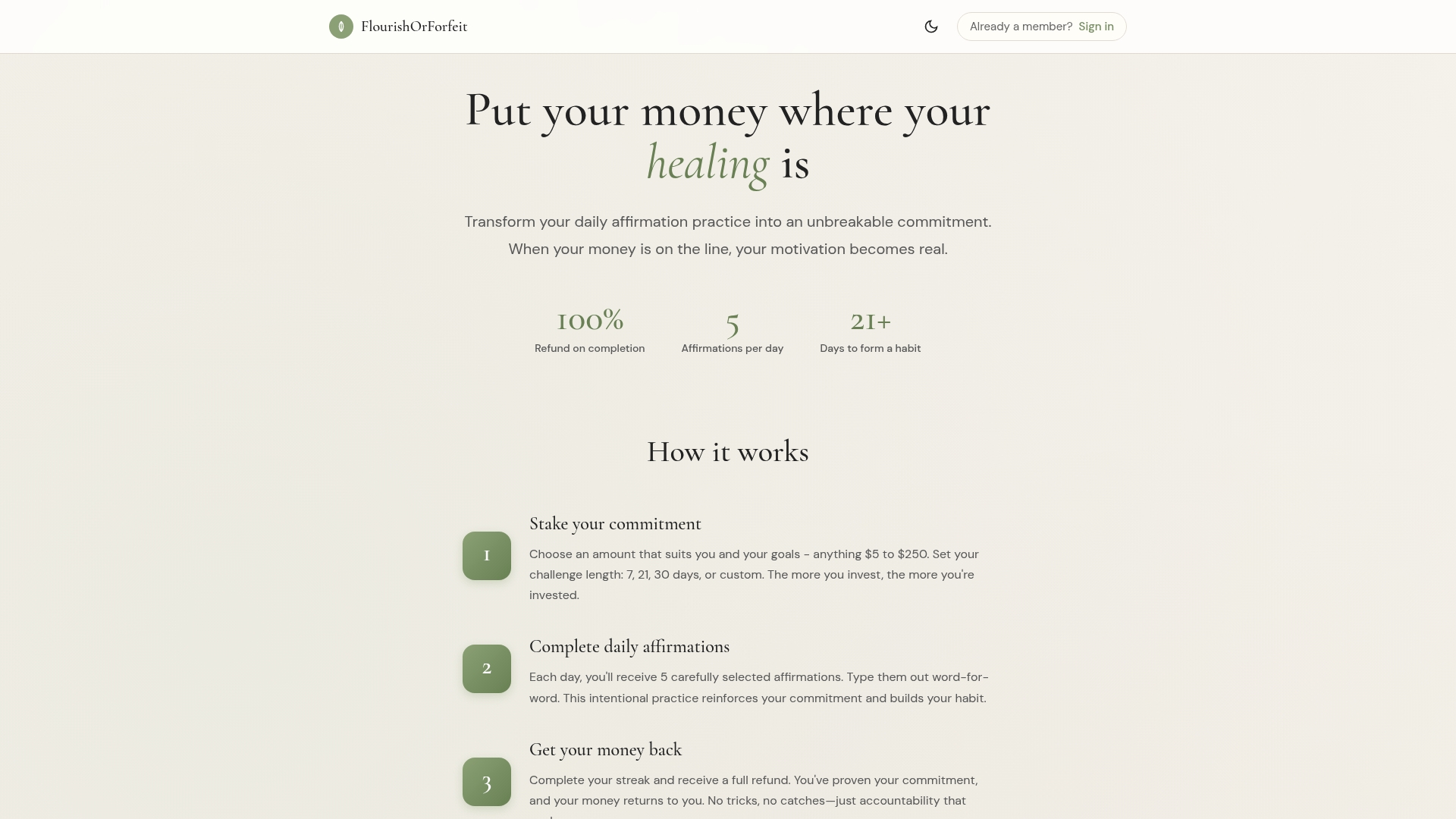
Here's how it works: you choose a stake between $5 and $250, pick a challenge duration of 7, 21, or 30 days, and commit to typing five curated affirmations word-for-word each day. Complete the challenge and you get a full refund. Miss a day without using your mulligan and you forfeit the stake. Payments run through Stripe, completions are verified via SMS, and your dashboard tracks every day.
Financial accountability works best for people who need genuine external friction — not just a reminder, but a real consequence. It's not for everyone, and it's not meant to replace the behavior-science fundamentals covered above. Think of it as an accountability layer on top of a challenge you've already designed well.
Start your challenge at Flourishorforfeit and choose the stake level that feels meaningful without being reckless. The refund on completion means the only cost of succeeding is nothing.
Useful sources and further reading
- Making health habitual: the psychology of 'habit-formation' and general practice — A PMC clinical review on context-linked repetition and why simple, anchored actions outperform ambitious ones.
- Time to Form a Habit: A Systematic Review and Meta-Analysis — The most current systematic review on health-behavior habit formation and its determinants; useful for understanding the wide individual variation in habit timelines.
- 30 Day Habit Challenge Framework That Survives Week 2 — The source for the 10-20 Ramp, flex-day scheduling, and the never-miss-twice recovery protocol.
- Flourishorforfeit — Stake-based accountability platform for readers who want financial friction added to a daily affirmation or habit challenge.