

The 21-day habit rule is a myth. Peer-reviewed research puts the average closer to 66 days, with individual timelines ranging anywhere from 18 to 254 days depending on the behavior, the person, and how consistently the behavior gets practiced. The 21-day habit myth persists not because it has scientific backing, but because it sounds achievable and has been repeated so many times that it feels true.
Two things worth knowing upfront:
- What 21 days is actually good for: A motivational push. Three weeks of daily repetition builds early momentum and proves to yourself that a behavior is possible. That's real.
- What it misleads about: Automaticity. Feeling like a behavior is effortless and happens without conscious thought, which is the actual marker of a formed habit, takes considerably longer for most people.
Key Takeaways
The 21-day habit myth is a misquoted observation from 1960, not a scientific rule. Peer-reviewed research puts the average closer to 59–66 days, with a range of 18 to 254 days depending on behavior complexity and consistency.
| Point | Details |
|---|---|
| 21 days is a myth | Habits average 59–66 days to form; the 18–254 day range reflects real individual variation. |
| Origin: Maxwell Maltz | The "21 days" phrase came from a 1960 observation about self-image adjustment, not habit research. |
| Consistency beats willpower | The Frontiers (2020) study found self-control did not predict habit formation; consistent repetition did. |
| Measure automaticity, not days | Track how effortless the behavior feels (1–5 daily rating) rather than counting calendar days. |
| Flourishorforfeit | A financial-stake daily challenge platform that builds early consistency through real accountability. |
Table of Contents
- Does the 21 day habit myth have a real origin?
- What does peer-reviewed research actually show?
- Why do some habits form faster than others?
- How do you actually measure whether a habit is forming?
- What are the most effective steps to build a habit?
- Do commitment devices and accountability actually help?
- What does a realistic habit timeline actually look like?
- Why automaticity beats the calendar every time
- Flourishorforfeit turns daily affirmations into real commitment
- Sources
Does the 21 day habit myth have a real origin?
It does, and the source is more interesting than most people realize. In his 1960 book Psycho-Cybernetics, plastic surgeon Maxwell Maltz wrote that it takes "a minimum of about 21 days" for patients to adjust to changes in their appearance after surgery. He was describing psychological adjustment to a new self-image, not measuring behavioral automaticity in any experimental sense.
As UCL's Department of Behavioural Science and Health explains, Maltz's observation was anecdotal and specific to a narrow clinical context. The phrase got picked up by self-help writers, stripped of its original meaning, and repackaged as a universal law of habit change. By the time it reached motivational seminars and productivity blogs, "about 21 days" had become "exactly 21 days" and "adjusting to a new self-image" had become "forming any habit."
Jason Selk's Forbes piece on the 21-day myth traces exactly this amplification: the phrasing spread because it was optimistic, memorable, and fit neatly into challenge formats. None of that makes it accurate.
Pro Tip: When you see a "21-day challenge" framing, treat it as a motivational structure, not a scientific timeline. The challenge format can be genuinely useful for building early consistency. Just don't mistake completing it for a fully formed habit.
What does peer-reviewed research actually show?
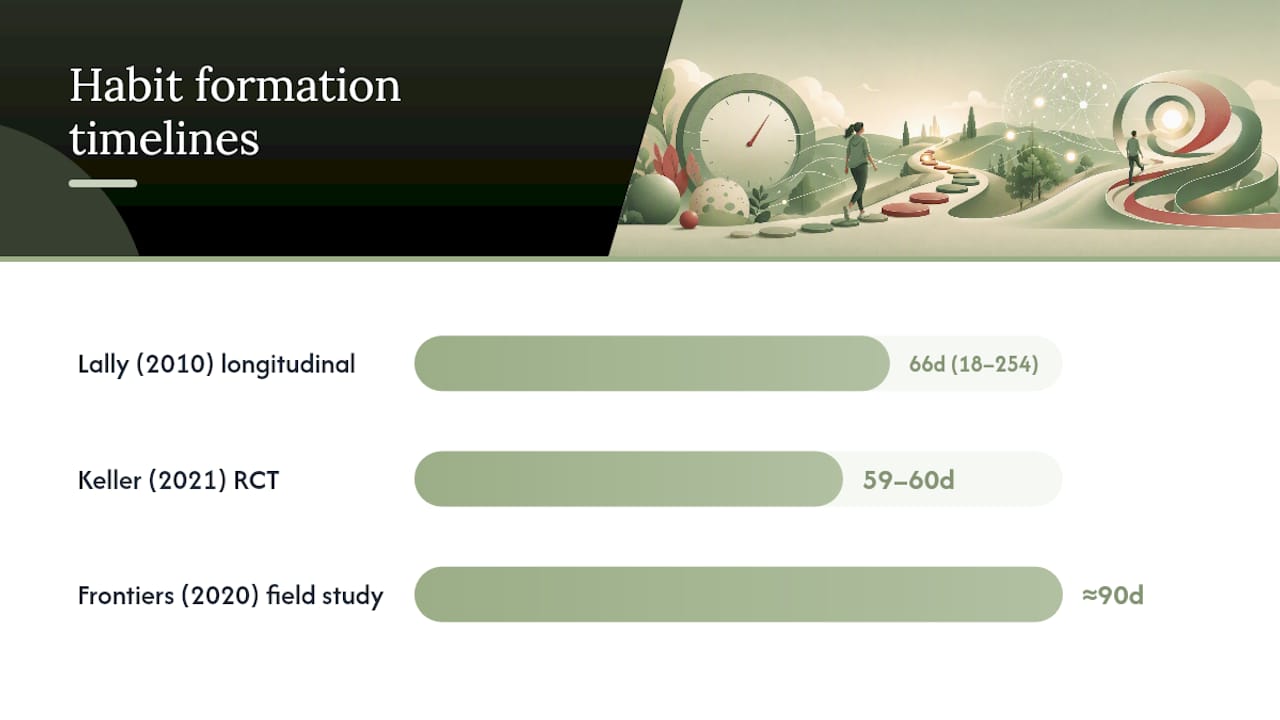
The most cited study on this question is Lally et al. (2010), a longitudinal study from University College London. Participants chose a simple daily behavior (drinking a glass of water with lunch, doing 50 sit-ups before breakfast, running before dinner) and tracked both their performance and their sense of automaticity every day for up to 84 days. Automaticity was measured by how much the behavior felt effortless, habitual, and hard to resist doing.
The average time to reach near-automatic performance was about 66 days. But the range was 18 to 254 days, which tells you more than the average does. A simple behavior like drinking water after a meal formed quickly. A complex physical behavior like a pre-dinner run took far longer. Missing one day did not derail progress, but inconsistency over longer stretches did.

A 2021 randomized controlled trial by Keller et al. added a useful data point: among participants who successfully formed a nutrition habit, the median time to reach 95% of their automaticity ceiling was about 59 to 60 days. Plan enactment, meaning whether participants actually followed through on their stated implementation plan, was the strongest predictor of success.
A 2020 longitudinal field study published in Frontiers in Psychology tracked habit strength over roughly 90 days and found substantial increases for participants who performed target behaviors consistently. One counterintuitive finding: self-control capacity did not reliably predict who formed habits. Consistency of repetition mattered more than willpower.
| Study | Design | Mean/Median | Range |
|---|---|---|---|
| Lally et al. (2010) | Longitudinal, daily self-report, up to 84+ days | ~66 days average | 18–254 days |
| Keller et al. (2021) | RCT, daily measures, 12 weeks | ~59–60 days median | Wide individual variation |
| Frontiers (2020) | Longitudinal field study, ~90 days | Substantial gains by ~90 days | Varies by consistency |
Scientific American's summary of the research puts it plainly: the 21-day idea is a popular myth, not an empirical rule. Behavior complexity and practice opportunities drive the timeline far more than any fixed number of days.
Why do some habits form faster than others?
The 18-to-254-day range from Lally et al. is not noise. It reflects real differences in how habits form. Four factors account for most of the variation.
- Behavior complexity. Drinking a glass of water after breakfast is a single, low-effort action with a clear cue. A 30-minute morning workout involves preparation, physical effort, and competing demands. Simple behaviors reach automaticity faster, sometimes in a few weeks. Complex ones can take months.
- Practice frequency and cue stability. A behavior practiced daily in the same context (same time, same place, same trigger) forms faster than one practiced irregularly. The brain encodes the cue-behavior link through repetition in a stable environment. Vary the context too much and that encoding slows.
- Intrinsic reward and immediate feedback. Behaviors that feel good quickly, or that produce an obvious result right away, tend to stick faster. The reward signal reinforces the cue-behavior loop. Habits with delayed or invisible payoffs need more deliberate repetition to compensate.
- Individual differences. Baseline routines, existing environmental structure, and how much a new behavior conflicts with current patterns all shift the timeline. Someone who already exercises three days a week will form a fourth-day habit faster than someone starting from zero.
Pro Tip: If you want to compress your timeline, pick the simplest version of the behavior first. "Drink one glass of water after breakfast" will become automatic faster than "drink eight glasses of water throughout the day." Once the simple version is automatic, you can build on it.
How do you actually measure whether a habit is forming?
Counting calendar days is the wrong metric. A habit is not formed because you hit day 21 or day 66. It's formed when the behavior starts to feel automatic, which means it happens with less deliberate effort, feels natural in its context, and is harder to skip than to do.
Researchers use the Self-Report Habit Index (SRHI), a validated scale that asks questions like:
- "I do this automatically."
- "I do this without thinking."
- "I would find it hard NOT to do this."
- "This is something I do without having to consciously remember."
- "This behavior is part of my routine."
You don't need the full academic scale. A simple 1-to-5 daily rating on "How automatic did this feel today?" gives you a usable trajectory. What you're looking for is a pattern, not a single number.
Here's how to interpret what you see:
- Weeks 1–3: Ratings will be low (1–2). You're still deciding to do the behavior consciously. This is normal.
- Weeks 4–8: Ratings should start climbing. You'll notice the cue triggering the behavior more reliably. Some days feel easier than others.
- Weeks 8–12: For many behaviors, ratings plateau in the 4–5 range. The behavior is becoming background. This is the automaticity asymptote.
- Beyond 12 weeks: Complex behaviors may still be climbing. If ratings are still low at 10 weeks, examine cue stability and frequency, not willpower.
The trajectory matters more than any single checkpoint. A steep early climb followed by a plateau is a good sign. Flat scores through week six usually mean the cue or context needs adjustment.
What are the most effective steps to build a habit?
The research converges on a short list of mechanisms that actually work.
- Implementation intentions. Write an if-then plan: "If [cue], then I will [behavior]." For example: "If I pour my morning coffee, then I will do five minutes of stretching." Studies consistently show that specifying when, where, and how you will perform a behavior significantly increases follow-through.
- Habit stacking. Attach the new behavior to an existing one. "After I brush my teeth, I will write one sentence in my journal." The existing habit provides a reliable cue without requiring you to manufacture one.
- Environment design. Reduce friction for the target behavior (put the running shoes by the door) and increase friction for competing behaviors (put the phone in another room during the first hour of the day). Environment shapes behavior more reliably than motivation does.
- Consistent cue and context. Same time, same place, same trigger. Varying the context slows encoding. Stability accelerates it.
A simple flow to start:
- Pick one specific behavior (not a category, a single action).
- Choose a stable, existing cue to attach it to.
- Make the first step so small it takes under two minutes.
- Track automaticity daily with a 1–5 rating.
- Check in at 21 days (is the cue working?), 30 days (is it getting easier?), 66 days (does it feel automatic?), and 90 days (is it consolidated?).
Pro Tip: The two-minute rule is not about doing two minutes of the behavior forever. It's about removing the activation energy that stops you from starting. Once you're in motion, you'll usually continue. The habit is the starting, not the duration.
Do commitment devices and accountability actually help?
Yes, and the mechanism is straightforward. A commitment device is any structure you put in place in advance that makes it harder to back out of a behavior later. The classic example is Ulysses having himself tied to the mast so he could hear the Sirens without being able to act on the impulse. The modern version is telling your coworker you'll send them your workout log every Monday.
Financial stakes are one of the most studied formats. When people put money on the line, the loss aversion effect, the psychological pain of losing something you already have, creates a stronger motivational pull than the prospect of a reward. Public commitments work through social accountability: the cost of backing out includes the discomfort of explaining yourself to others.
Commitment devices work best when the stake is meaningful but not so large it becomes paralyzing. A $20 stake on a daily habit creates real skin in the game. A $500 stake on a behavior you've never tried before creates anxiety that can backfire.
Buddy systems add a social layer: regular check-ins with a partner who has a similar goal increase adherence because the cost of skipping is no longer private. The combination of financial stakes and social accountability tends to outperform either alone.
- Financial stakes: Effective for behaviors with clear daily completion criteria. Works best when the amount is personally meaningful.
- Public commitment: Effective for behaviors where social identity is at stake. Telling people you're training for a race is a commitment device.
- Accountability partners: Effective for sustained habits over weeks and months. The relationship itself becomes part of the cue.
Pro Tip: Match the commitment device to the behavior's difficulty. A 7-day financial stake is a reasonable test for a simple daily behavior. A 21-day stake makes sense for building early consistency. For complex behaviors, a 30-day structure with a mid-point check-in tends to outperform a single long commitment.
What does a realistic habit timeline actually look like?
Forget the magic number. Here's what the evidence suggests at each checkpoint, based on the Lally and Keller findings:
- Day 21: You've proven the behavior is possible for you. The cue is probably working. Automaticity is still low. This is a motivation checkpoint, not a finish line.
- Day 30: Early routine is forming. The behavior is easier to remember and slightly less effortful. You're roughly halfway to the median automaticity point for simple behaviors.
- Days 59–66: The median automaticity point across multiple studies. Many everyday behaviors feel close to automatic here. Complex behaviors are still climbing.
- Day 90: Consolidation. For most behaviors, habit strength has plateaued or is close to it. A 2020 Frontiers study found substantial, consistent gains through this window for participants who stuck with their target behavior.
Three behaviors mapped to expected difficulty:
- Drinking a glass of water after a meal: Low complexity, daily opportunity, immediate feedback. Likely to reach automaticity in the 3–5 week range.
- Handwashing at specific moments: Moderate complexity, multiple daily cues, clear completion. Typically 4–8 weeks.
- 30-minute daily exercise: High complexity, preparation required, competing demands. Often 2–4 months, sometimes longer.
The practical takeaway from UCL's guidance is to anchor your expectations to "weeks to months until it feels automatic" rather than a fixed day count. Use the checkpoints to evaluate and adjust, not to declare victory or failure.
Why automaticity beats the calendar every time
The most common mistake in habit building is treating a day count as the goal. It isn't. The goal is a behavior that happens with less and less conscious effort until it's simply part of how you operate. That shift, from deliberate action to automatic response, is what the research measures, and it doesn't happen on a schedule.
What I find most useful in the Lally and Keller findings is the range. The 18-to-254-day spread is not a flaw in the data. It's the honest answer to the question "how long does this take?" Some behaviors and some people get there fast. Others take most of a year. Pretending otherwise, with a tidy 21-day promise, sets people up to quit right when the real work is beginning.
The automaticity-based approach also changes what you track. Instead of crossing off days on a calendar and hoping something clicks, you're watching a real signal: how effortless does this feel today compared to last week? That's a question you can answer honestly, and the answer tells you whether to stay the course or adjust the cue, the context, or the behavior itself.
Flourishorforfeit turns daily affirmations into real commitment
If you want a structured accountability system that puts something real on the line, Flourishorforfeit is built for exactly that. You stake between $5 and $250, choose a 7, 21, or 30-day challenge, and complete your daily affirmations by typing them word-for-word. Finish every day and you get a full refund. Miss a day and you forfeit your stake. Payments run through Stripe, and longer challenges include a mulligan for one missed day.
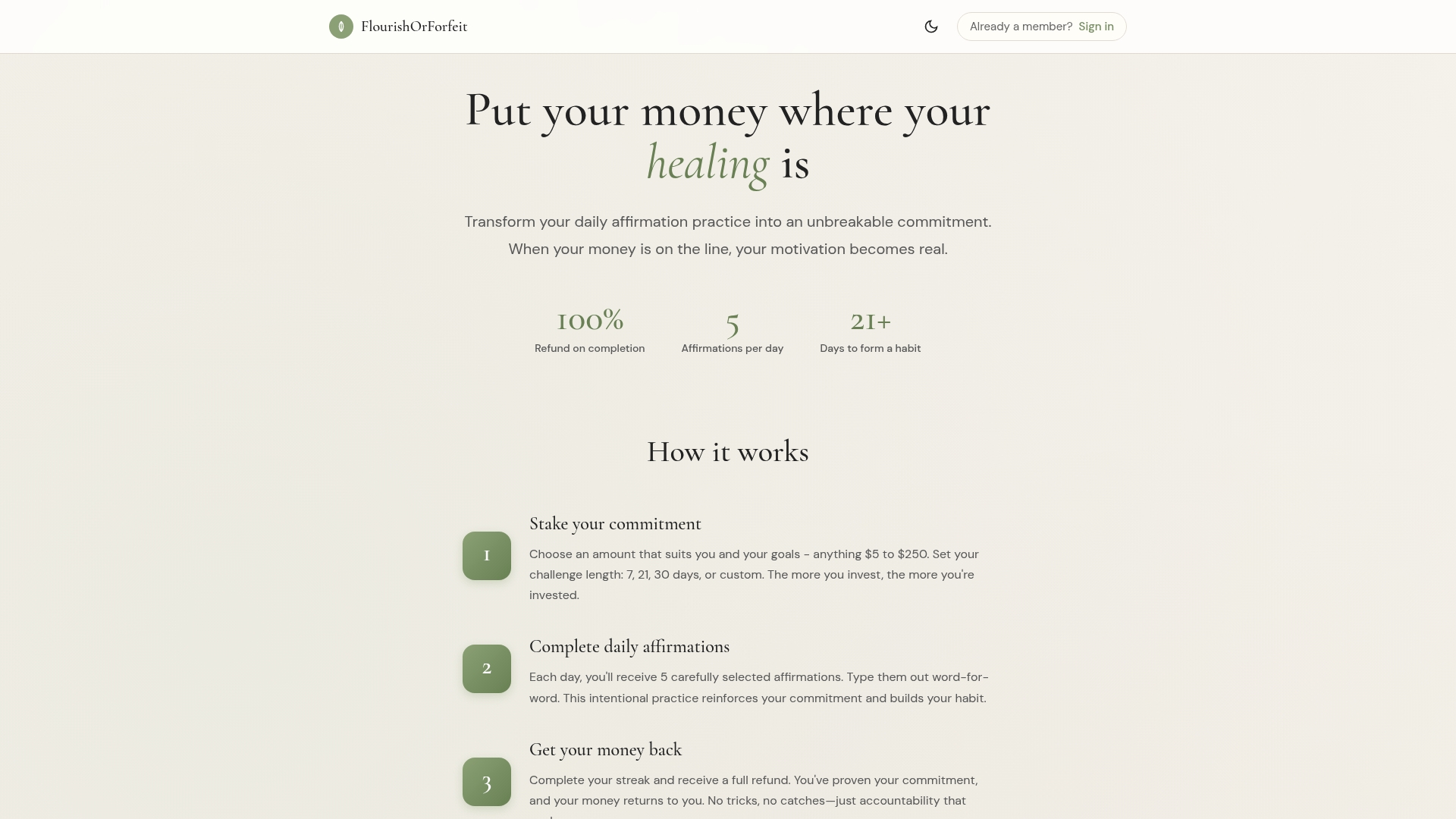
The model works because it converts the abstract intention to build a habit into a concrete daily action with a financial consequence attached. For people who respond to loss aversion, that's a more reliable motivator than willpower alone. The 21-day challenge format aligns with the early consistency window the research identifies, and the 30-day option takes you closer to the median automaticity point for simpler behaviors.
Start a challenge at Flourishorforfeit and put your commitment where your intentions are.
Sources
- How are habits formed: Modelling habit formation in the real world - Lally - 2010 - European Journal of Social Psychology - Wiley Online Library
- How long does it take to form a habit? | UCL News - UCL – University College London
- Busting the 21 days habit formation myth | UCL ‘Health Chatter’: Research Department of Behavioural Science and Health Blog
- How Long Does It Really Take to Form a Habit? | Scientific American
- Habit formation following routine‐based versus time‐based cue planning: A randomized controlled trial - Keller - 2021 - British Journal of Health Psychology - Wiley Online Library
- Frontiers in Psychology article reporting a longitudinal study on habit formation (2020)